“You owe your existence to magnetohydrodynamics,” my mother said.
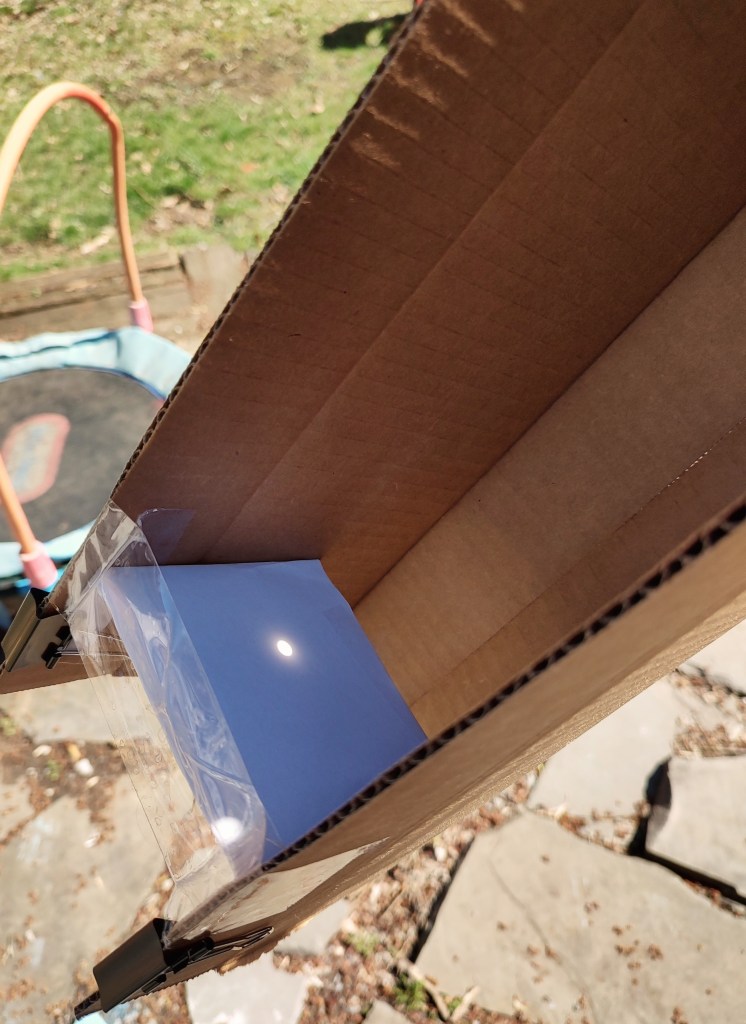
She was fighting through the vague instructions for the solar viewers that one of her acquaintances had shared online, originally from someone with a background in something optics-related. We had popped the lenses out of +1.50 reading glasses. She was in the process of figuring out the tubing part with the long, thin cardboard box. The lens would project an image of the sun onto a back panel, much like how the eye works.
While she fought with the box, she told me that, in the mid-early 1980s, she had been reading an astronomy magazine article about magnetohydrodynamics and the Sun, a model that is used in solar physics for the Sun when thinking about plasma and the Sun’s magnetic fields, and had a sudden thought that she needed to get involved in a local astronomical league. She connected with the one in Syracuse, NY, at that time, and met my dad a few years later at an amateur astronomy event.
This led to family priorities in my childhood like pulling me out of school for the 1994 annular solar eclipse and awakening before dawn on June 8, 2004, to see the first of the transit of Venus duos through my dad’s solar telescopes on a hillside where my delicious blood provided mosquito protection to everyone else. (I have memories of being a small toddler and playing in the base of my family’s enormous blue Dobsonian.) These circumstances also led to, several months after my birth at my first Stellafane Convention, my mother being interviewed for a piece on kids at Stellafane and saying jokingly to the journalist that I was a refugee from Betelgeuse … which is how she learned the hard way that you don’t joke around with journalists.
[Her father] holds [her] up to a telescope to see the Moon, and she turns her head toward it. She really can see the light! Mostly, though, she does naked-eye observing, but even [her father] will tell you it calms her down! She’s had a five-week course in astronomy already. She gets a lesson every day. We think she’s a refugee from Betelgeuse. I tried reading the three volumes of Burnham’s Celestial Handbook to her, but she likes 1937 [note: this date doesn’t make sense, and I think it’s a journalist error] issues of The Sky better. Most often she prefers Walter Scott Houston’s articles.
Thankfully, though, it was part of a larger quotation.
This is why my first word, spoken way too early (my mom says five months), was Moon. Astronomy is what brought my parents together, but it wasn’t strong enough to keep them together as the years went on.
The solar filter on my mom’s now-vintage Celestron — the model where the autoguider needs to be plugged in because batteries weren’t used for that yet — was one of the casualties of the splitting apart, and we learned the day I arrived and she took it out that Celestron’s current solar filters are not back-compatible with earlier models of the telescope.
(It’s a shame the equipment isn’t compatible. I prefer the telescopes from before they started building models where you have a keypad to put in celestial coordinates, where the autoguider (to make the telescope keep pace with the stars) is the only electronic tech on the machine. You can look up hundreds of professional astronomers’ image compositions of M81 and M82, but it’s an entirely different experience to painstakingly study a star map so you can star-hop to find them in your own telescope because they are faint, and it’s really hard. Especially in winter, when it’s 13°F/-10.5°C and you can’t feel your hands, like the time I was up on the rooftop in college during January term learning how to use a CCD camera. That’s when the price on those had come down enough that liberal arts colleges’ astronomy departments could afford to integrate them into observational astronomy classes, and I was a TA. Anyway.)
For this year’s eclipse, we had solar binoculars, though, and eclipse glasses, and the cardboard-and-reading-glass-lens tube. It was mostly clear outside, so we tried everything out. That evening, we went to a nearby lake because my mom and her friend who flew into the UK are now very into birding.
The morning dawned mostly clear, even though the forecast was muddled and messy later in the afternoon. My mom woke me up at 5 AM so we could get to the Montezuma Wildlife Refuge at 6:30 AM. We listened to her prog rock eclipse playlist on the way, and we were the fourth or fifth car there despite leaving briefly to get coffee at a nearby gas station — everything Tasty Caffeinated Beverage-related near Seneca Falls seems to be tourism-related, and it’s not tourist season. We got a great parking spot, and the lot filled at 9:15 AM.

While my mom and her friend birded, I meditated on a log and prayed for a short while, both a general prayer and a prayer to please, please, please be able to see totality (just like everyone, but the clouds have to go somewhere), finishing just before things started to get wild with the parking situation and people coming in. At one point, there were state police with megaphones telling people they are not allowed to park on the rural highway and come into the park. It was wild.
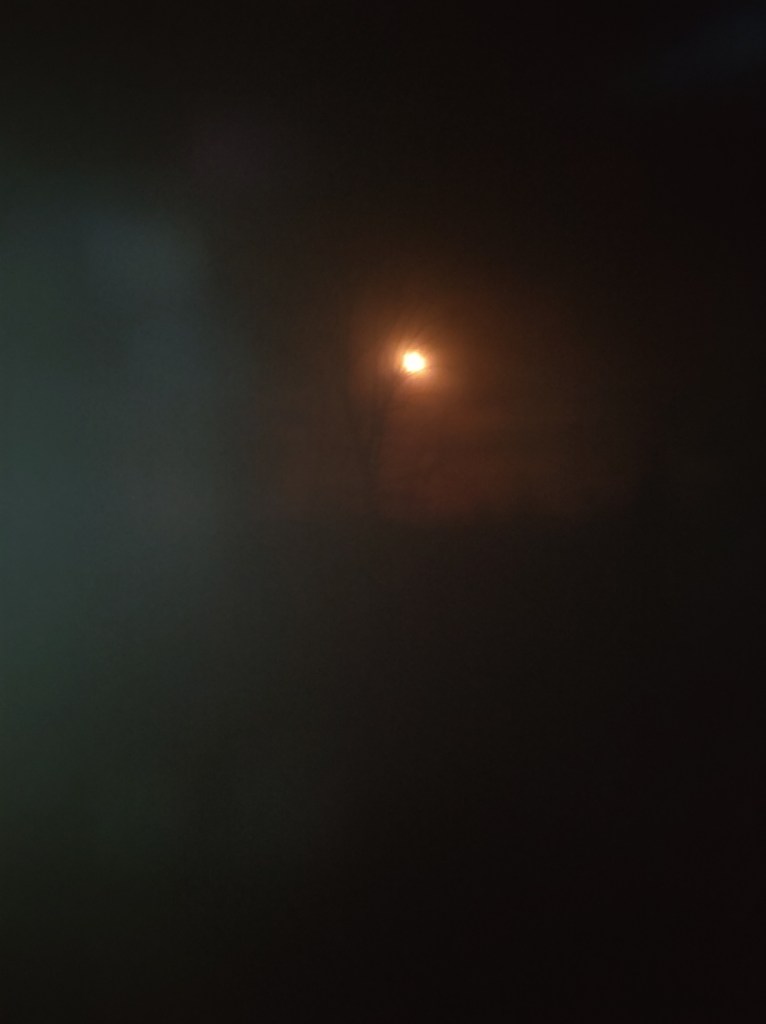
The clouds rolled in about fifteen to twenty minutes before first contact. We saw glimpses of the Sun through the clouds during the eclipse, a great shout rising among the crowd every time we saw it.
Even though I couldn’t see the corona like I wanted (hey, there’s always Greenland, Iceland, or Spain in 2026), what surprised me about totality — as someone who has seen eclipses since my childhood, where my mom’s proud comment about me is that I had said at the age of six that it’s easy to see how an asteroid could cause a mass extinction if it got so cold after only a few minutes of something blocking the sun — was how total it was.
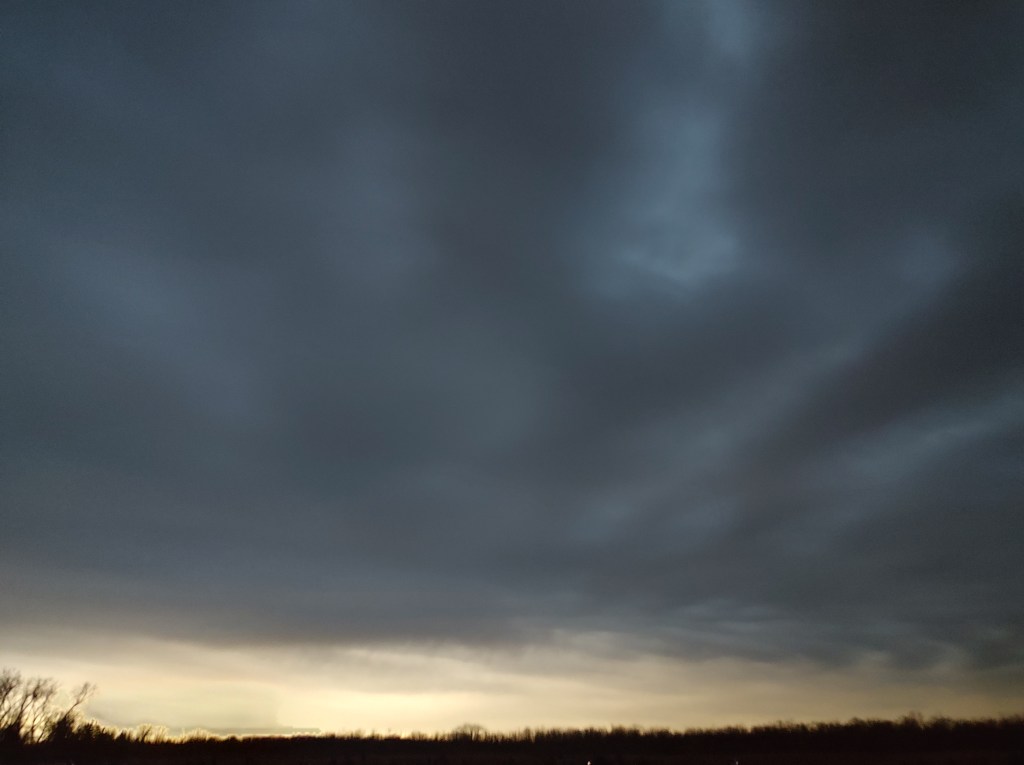
It is the only moment in my life when I have felt the moon as a body physically, looming up there. It’s easy not to think about most of the time when I see it. Its shadow cast a 360-degree sunset around us, and the breeze picked up heavy and cold. Because we were at a bird refuge, we got to see the wildlife react. They sang as totality approached, and during totality, they flew and sang and jostled in utter confusion. It was amazing.
Most people left after totality had finished. We stayed until the eclipse was over, catching glimpses of the sun’s partiality through the clouds. The sun came out from behind the clouds about three or four minutes before the eclipse ended. It was sunny and beautiful for a time. As we drove to my mom’s house, we found rain for a few minutes on a rural stretch of road.
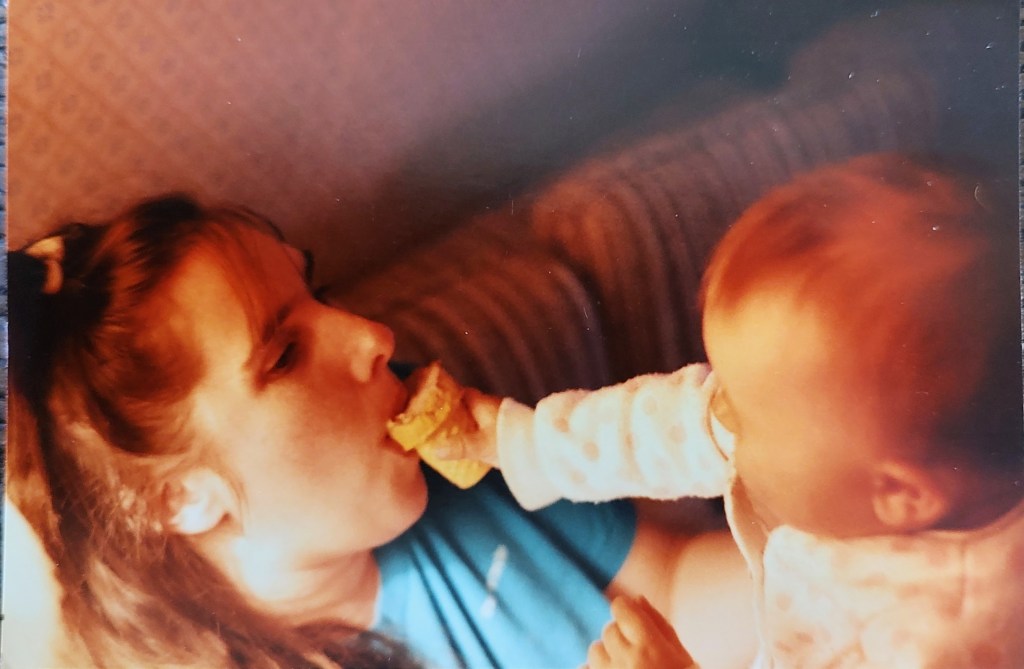
I was a tad upset about not seeing the corona during totality. It occurred to me that had I stayed out of Upstate NY, I could have gone up to Vermont or Maine, where they had clear skies, but I had been too attached to the idea of going to my mom’s, where I had not been since my youngest sister’s wedding in 2018. It had been a bad decision for a few reasons. The only good things about being in Upstate NY specifically were getting to hang out with my mom and her husband and friend plus being able to go through old family photos for the first time in over half a decade. They could have driven to New England, though.
While heading up to my mom’s, I read the Rites of Nature issue of Orion magazine, which originally attracted me for this article on plants as honored guests in South Asian wedding ceremonies. It had other enjoyable articles, including one about Beyoncé and the Orisha symbolism that is more and more present in her work. For the most part, though, the pieces were written by people wrestling with their Christian upbringing and trying to figure out what it meant to them and how it relates to environmentalism now that they feel utterly disconnected from the routines and rituals of a church. I found this sociologically interesting until, most of the way through Martha Park’s essay about natural burials and their appeal to Biblical literalists, she wrote,
I found myself telling [Kellye Par] the same story I’d told Mat Kelley at Grace Church: the Christmas Eve service, my first time in a church since my father retired, when I cried every time the pipe organ bellowed or we bowed our heads in prayer. It still confounded me.
“You’ve experienced a death,” Kellye said. “But you don’t yet have a ritual for grieving it.”
When I’d told Matt about the Christmas Eve service, the story seemed to demonstrate a longing for continuation; it implied that I was on a journey that would lead me back, in some way, to the place where I began. In my insistence on finding some coherence, I’d managed to avoid seeing — and grieving — an ending for what it really was. I’d grown up with the rare gift of a religious community in which I felt safe and loved; with a faith that was nurtured within and alongside my doubts. My life had been utterly shaped around walking into church and seeing my father in the doorway, and now there was no church, anywhere in the world, where I could find him in a pulpit on Sunday morning.
Martha Park, “Natural Ends: Green burials offer new ways back to ancient lands,” Orion Magazine, Spring 2024.
I hadn’t expected to find a sense of community in those words. In fits and starts while I was Upstate, I reflected on how much I feel like a failure as a person knowing that we had intergenerational pagan continuity through my mom and me, but it ends with me because my sisters have both converted to Christianity. I would rather have had a story of success, not a story of intergenerational piety dying like the plants at my windowsill that I always seem to kill no matter what I do.
And the community I grew up in (sort of) died. P. and S. had been handfasted, but not married, and they were the ones who welcomed us to circle. One day, P. told S. that he wasn’t in love with her anymore. He left her with nothing, and she had no protections like she would have had had she been married. It split everyone in the community in half. S. had always been a kind person. P. is apparently just as cruel when he talks about S. as my dad is when he talks about my mother.
A long time ago, while in the Hannibal pagan store looking at things, my mom and the owner started talking in hushed tones. They were friends. I think they went out to lunch sometimes. The owner had once been married, but it had been short-lived. She could perform legally binding handfastings, but refused to because she didn’t believe in marriage after what she’d been through. They were talking about someone whose husband had kicked her out on the street with nothing. I couldn’t comprehend back then how someone would be so unfair as to force someone out without anything. What if there had been precious family photos inside or a memento from one’s ancestors? What if she had no underwear or had left her wallet inside? The owner looked at me and said that none of that mattered, but I didn’t understand. It’s an abuse of a relationship’s power dynamics to end it and then shame someone like that or try to harm them, even if the relationship didn’t end on great terms. The first time I started to comprehend the depths of human cruelty was the first time I watched someone in the pagan community getting eviscerated and doxxed online, and I deepened my understanding after I started donating to refugee and medical crisis organizations because I receive reports from them. There’s an awful capacity for wantonly cruel individual behavior and/or groupthink in our species.
There wasn’t a moment when I grieved the pagan community that I had in my childhood properly. I realized while journaling after the eclipse that that is why thinking about my family situation sometimes makes me burst into tears. Truth be told, the family stuff has been so raw inside that I haven’t prayed at the ancestor shrine in a long time. I thought on Monday night that maybe my mom was being strangely prescient with her joke about me being a refugee form Betelgeuse — maybe she was picking up on that sense of liminality that seems to have characterized my life. Of being from one place and being forced violently into an alien one. “This being human is a guest-house,” as Rumi says, playing with a concept in Epictetus.
Embodiment is a lot like the experience of a total solar eclipse. Whether we engage in apotropaic practices or use it as an opportunity to view the celestial bodies and expand our awareness or a combination of both, we come into each lifetime and are met with challenges. A lot of our own inner light is blocked by the factors that come into play in sublunary existence — but the light is always shining behind it all, the horizons are all bright, and the presence of the corona means that we emit our light even in the face of strife. I was thankful to see it and to have the opportunity to process a lot of things that I had not adequately processed — to realize that I needed to grieve intergenerational pagan continuity in my family in order to move forward and worship the Gods properly and become the kind of person I want to be — someone who eats her vegetables and gets the medically-recommended amount of cardio and weights exercise, who keeps up with her medical appointments, who has cats whom she loves and who seem to care about her, who can travel to visit totality in 2026 in a country with less cloud cover, who still has her pagan mother, and who is cultivating her own sense of religious and spiritual community instead of nursing nostalgia about what was. There is a lot in my life that is going okay, and properly grieving makes new space for the good things to grow.
I hope everyone who saw the eclipse had a great time of it, like I did, even if you don’t owe your current birth to magnetohydrodynamics in precisely the same way.

 KALLISTI