Last spring, in late May just before the Thargelia, I sat down for a podcast interview that I had pushed way back. There was a lot happening at work that late winter and early spring, and I didn’t know what my energy would be like. I also felt a lot of dread about it due to a lot of interpersonal online things that had been happening since 2018 or 2019 that have bewildered and confused me for quite some time.
When the interview was done, I had the thought, “It’s finally over.” The thought scared me a bit, and over the year between then and now, I have decided to not post on KALLISTI anymore. I’m still keeping the site up, but I have disabled comments on it.
My autism diagnosis in early 2025 gave me a lot of clarity about things online. It made me realize that the reason microblogging didn’t work for me was that it left too much up to context and misinterpretation. People online are also very cruel, and regardless of how many statements people sign about inclusivity, for most, it’s more about clout than sincerity. They still foment and participate in a lot of behaviors that show that the signatures have not, and probably will never, translate to actual real-world training on how to handle difficult situations, let alone basic mediation skills or intercultural awareness. I have no trust for anyone involved in microblogging.
I had been trying very hard for so long to follow evidence-based practices about deradicalization and bridging while having a social disability that I didn’t know about, and above all, it seems like people without such social disabilities do not have any motivation to make this sort of effort. I felt burned to cinders inside from thinking through all of what was happening with that new insight.
My prayers at shrine were a mess. I kept thinking about how my autism had kept me from connecting properly with my siblings because autism makes me inflexible about certain ethical and moral positions I have. I also ruminated about how it was essentially my disability’s fault that I didn’t recognize that they were craving connection when we were all younger and that I could have made an effort to include them in rituals instead of doing my own thing. These were things that a nonautistic older sister could have done. I knew that this anger was unhealthy, so I started doing self-help workbooks, and I got on the waitlist for a therapist.
There was a lot of masking stress that I was under online. I have a lot of rigidity that I tend to push down because I know it makes others uncomfortable. One, I care about the environment in a country that doesn’t accept the existence of human-caused climate change. Two, I’m fairly routine-driven. COVID-19 was also a uniquely stressful time for me because I was already extremely predisposed to being massively stressed out by people not following said guidelines. I had been coughing into my elbow since seeing a news feature about it when I was a child and had spent years restraining myself from chiding people in public, coworkers, and family members who were coughing into their hands because they never reacted well when I told them to change their behavior. I had envied East Asia since about 2013 or 2014 when I learned that people who are sick frequently mask in public in many East Asian countries. People who are casual about illness or being sick have enraged me since I was an actual child. It was a lot. One of the things I’ve always liked about online communication is that I can have a complete meltdown in the privacy of my home without anyone knowing it or treating me differently, where the shame is more transient. A cloudburst — transient weather. These happened a lot then.
As I’ve mentioned on this blog before, I’m also very angry at the idea of missionary activity, and this rage was first activated when missionaries were withholding water from tsunami victims after the 2004 disaster. People thought I was anti-Christian before 2016 and 2024 when I told them basic facts about Christian behavior in the Midwestern USA or tried to explain what Christian charities actually do abroad and how individuals are responsible for it if they willingly donate money to those organizations. I spent a lot of time scripting to try and figure out socially polite ways to talk about this and still had issues.
Maybe how I feel about Influencer culture is related to that. Maybe some of the grueling effort I brought to The Soul’s Inner Statues was wanting to give people an option for learning daily practices that didn’t require them to swear an oath of loyalty or join someone’s cult community.
I used to do a lot of scripting for blog posts and try to examine them from every angle and think through reader personae to ensure that the posts landed decently, all before even writing a post out, and I would add and change things until I’d made something that said what I wanted to say while preempting what I could.
Back when I was more active online, I imitated the behaviors that people online expressed in videos and blog posts, during which they overshared, because I thought that was the way that things were done. After diagnosis, I took a step back from that, especially because I was missing a lot of subtext.
Subtext is impossible to navigate on microblogging platforms. I realized I could never communicate with others on them. My anxiety around processing what had happened online also led to changes in how I was around people in general. I realized that I had to put myself on fairly narrow rails and be as polished as possible. I also struggled to read most things on the polytheistic blogosphere because the moment I went onto WordPress or Substack or into polytheistic chat spaces, I’d feel my mind start racing and my chest tense. I also avoided podcasts, except for The Emerald and Nordic Animism, which didn’t cause that reaction because I hadn’t engaged with them back while everything was happening.
When I have image management fears, they’re always about trying to protect myself from other people because I have a history of being bullied, and also a history of being bullied without realizing I’m experiencing social violence until the perpetrators finish stringing me along. That, and people reading into what I’m saying things I haven’t said. Some of the brain fog, panic, and fear was related to having done The Soul’s Inner Statues and feeling like a failure, that if people knew I was struggling, or because I’d been so autistic that my diagnostician said I would have been identified as a kid had they been diagnosing girls because it was very obvious, that the work I had done had no value because the sort of person who wrote that was also the sort of person who couldn’t have a mental health cascade during a surgery journey.
Being avoidant was somewhat stabilizing, although it meant that I had essentially cut off my capacity to engage with other people, which is flagged by health professionals based on decades of studies on loneliness. Not that bad means that I was doing things like:
- sending postcards
- emailing my elected officials
- volunteering on quieter weekend morning volunteer opportunities
- managing my energy and capacity
- being quiet(er) on this blog
… even though I was also:
- trying to be extra accommodating to people because I knew that my inflexibilities were too much
- silencing myself when I wanted to say things, just generally online, but also in a reading group I was in, because the back-and-forth was too socially stressful
- avoiding interactions where I knew I couldn’t mask well enough
- falling into a scrolling addiction driven by dread and apprehension and the current circumstances in the USA
None of what was going on with me was without precedent. When I was in middle and high school, my mother forced me to get out and socialize at school dances. In eighth grade at a dance, I was surrounded by the group of boys who were bullying me at school, and they pressed in close to me and ground their bodies against me. I broke out of the ring of them and cried in the bleachers of the gymnasium where we had dances for hours. I never told my mom. While I’d always reached a dreamy, not-really-there state around 10 or 11 PM during these dances, every dance since then, I’d be fine for an hour to an hour and a half, and then I would start crying.
What happened, and being vigilant about avoiding it happening in the future, was very hard psychologically. Having undiagnosed autism, I also know in retrospect that I was having sensory overwhelm and had hit my stimuli budget. Those boys were bullying me because I wasn’t following social rules for girls, and they were trying to fix a problem (me) in the most shaming way they could think of. Not being able to read blogs or go into online polytheist spaces without feeling my chest tighten and my brain fog up felt a lot like how I feel thinking about going to dances.
Once I knew about the autism, I realized that things like this would just keep happening, each scenario unique, but with the same basic elements. I would be misunderstood, people would be punitive in whatever way they thought acceptable, and I would have to deal with the consequences. The only difference is that, knowing why, and knowing that most inclusivity pushes are not real (especially when people with Influencer ambitions are involved; trusting them is like trusting corporate HR), and having the freedom to leave, nothing is barring me from walking out the door.
It took me almost a year to cry in front of my therapist because I’m afraid of crying around people. I usually hide the moment I realize it’s about to happen unless I can’t escape (like in an airplane in early June when we were delayed and I got overwhelmed), even from close family, because crying bothers others. When it happened in therapy this spring, it was while I was trying to explain the online things. I had what was probably something like a panic attack thinking about all of the times I haven’t been understood (because other people read into things I say or do instead of taking them at face value or asking questions) and how much anxiety and fear I have around that happening again, despite its inevitability. Even after a year of therapy, I am not convinced that I’m not too much or too weird or too socially inept for other people, even the neurodivergent ones. I have a really hard mental health time every time I accidentally let my guard down wondering if something bad will happen.
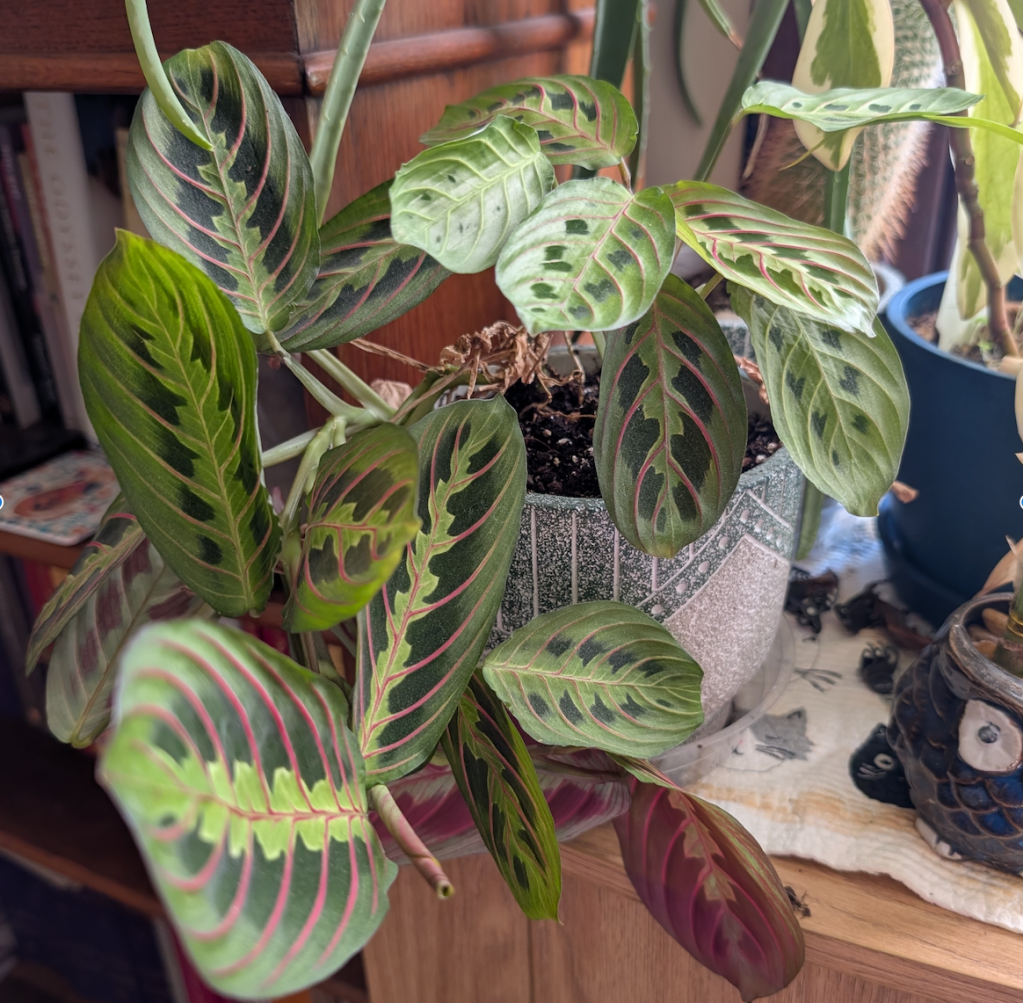
For several years, my prayer plant had barely been surviving. It went from being lush a few years ago to slowly losing leaves and shrinking back into itself. I kept moving it around my apartment trying to figure out if the light was not appropriate for what the plant needed. Nothing worked. It shrank back to a few resilient leaves on a single stalk, and even most of those leaves shriveled up. Eventually, I removed it from its original pot and replanted it in a much smaller one. I put it among the community of plants at my southeast-facing window, and I watched and waited to see if it would die completely.
Slowly, more leaves appeared on it. And then I repotted it in mid-May.
I started trying to follow my own advice in The Soul’s Inner Statues. I managed my expectations around my prayer routine, with the focal point of my mornings shifting to the solar prayer with my tea, and the prayer at shrine being shorter or longer depending on what I have capacity for. I made peace with dismissing the rambling walls of text I had written and discarded for being too raw and emotional, definitely rightly. It is a good book for messy humans working through messy lives, and I’m happy to have written it. “What you have discovered is a recipe not for memory, but for reminder,” as Plato’s Socrates says. The somatic practices I was learning from my therapist were starting to help my spiraling.
I repotted my orchids a week after the prayer plant. While waiting for the orchid soil and hole-y pots to arrive, I thought about how the flowers’ appearance and disappearance mirrored the “life, death, life” of reincarnation, and I thought as well about Dionysos and Persephone. One of my orchid plants — the black jewel orchid — wasn’t doing well, much like the prayer plant hadn’t been doing well. I took two cuttings from it and repotted it. The roots began to fill out.
In Katharine K. Wilkinson’s Climate Wayfinding, I am struck by the phrase, “In a very literal sense, we find ourselves facing a world where maps increasingly no longer work” (p. 4). Later on, Wilkinson asks, “What already gives you sustenance amid the swirl of yet?” (p. 13). She recommends listening to Tracy Chapman’s “Crossroads,” which I hadn’t encountered before. I cried. Wilkinson’s question of yet led me to write a list, which led me to create the first draft of this post in mid-May.
I am trying to figure out what the next chapter of my life looks like while the world burns and floods in both metaphorical and literal senses. I am trying to figure out how to balance what I know about the evidence-based research that loneliness is like smoking against the aftermath of social trauma, where what should be nourishing feels like eating food spiked with tiny shards of glass. Climate Wayfinding is meant to be read in community, in being with others. It is very lonely to read it feeling as if I have to go it alone because I’m never going to belong anywhere as myself. A blog on the open Internet is coastal house on stilts, vulnerable to waves and hurricanes. It is not a solid place on dry land to gather with others from the heart.
The next chapter of my life does not involve blogging on KALLISTI. Most of it is too personal or particular or partial for this space. That’s one of the things I found very difficult about a social thing from last year, that we were reading things about providence and human life at about the same time I was going through so much in my personal life, but I couldn’t bring anyone else into my messiness. I’m in a phase of my life in which I really do need to work on sorting out my immediate embodied context.
The Internet has changed a lot during my lifetime. It is now a place where everything should be polished output — it apparently shifted from being a place to be a person to being a place to be a content marketer a while ago — so I’m shifting my attention. Trying to say things apart from through creative writing is not effective for someone with no Influencer ambitions, so I should stop. In analog life, I’m focusing a lot on supporting transportation revolutions and the sorts of things that will liberate most people from atomized, isolated, and estranged situations caused by being carlocked and car-dependent. It’s prosocial applied worldbuilding, a way to relate to others, Gods willing, even if I feel like I am too much and am constantly anxious now that I’m doing something wrong and just not realizing it.
KALLISTI gets a lot of traffic from AI summarizers because most of the content is pre-11/2022, the gold standard for human writing. It will probably stick around for this reason.
I think a lot of people could take the wrong thing from a statement like “leaving” or “stopping” because they did not grow up in polytheism. I’m pagan, and a polytheist, regardless of how much I am doing elaborate rituals at shrine, or how much I’m talking explicitly about it online, because it’s a perspective that I simply bring to my life. It isn’t a consumable that is depleted and which needs to be refilled. I’m also not completely leaving the building, so to speak, because there are spaces where I sometimes have energy and capacity and risk assessment optimism to interact, especially as I have a somatic therapist and am sorting through ways to manage and process social trauma. Still, part of me smiles every time I think, “Wow, I’m about to become a somewhat private person.” I’ve thought about Odysseus in Plato’s Myth of Er passages quite a lot over the past few weeks while cooking dinner.
While it is sad to leave blogging, it feels like a weight being taken off of my shoulders, and on the other side of the transition, there could be something like eudaimonia.
Happy 39 to this life.